
Intervention: Nutrafol Build-Up Blocker Scalp Microbiome Exfoliating Mask (n = 38), Nutrafol Root Purifier Scalp Microbiome Shampoo (n = 37), Nutrafol Stress Reliever Scalp Microbiome Essence (n = 33) and Nutrafol Strand Defender Lightweight Protective Conditioner.
Methods: All products underwent in vitro analysis to evaluate their ability to modulate bacterial and fungal colonies.
Individual products were subsequently tested clinically: Build-Up Blocker Mask was evaluated for sebum build-up; Root Purifier Scalf Microbiome Shampoo was evaluated for sebum build-up and hydration, plus expert scoring for flakiness; Stress Reliever Scalp Essence was evaluated for sebum content and hydration, plus expert scoring for redness and flakiness; Strand Defender Lightweight Protective Conditioner was evaluated for its properties in decreasing snags, entanglements and abrasion between hair fibers on bleached hair.
Study Duration: Varied; up to 28 days
Eligibility Criteria:
- Nutrafol's Build-up Blocker Mask: Subjects with moderate-to-high sebum build-up.
- Nutrafol's Root Purifier Scalp Microbiome Shampoo: Subjects with oil, dry and/or a self-perceived sensitive scalp.
- Stress Reliever Scalp Essence: Subjects with an irritated scalp.
Key Findings
1
Nutrafol’s topical products were evaluated in vitro to determine their impact on microbial species that inhabit the scalp, such as Cutibacterium and Staphylococci. Outcomes of this assay confirmed that the products maintained appropriate levels of scalp microbes.
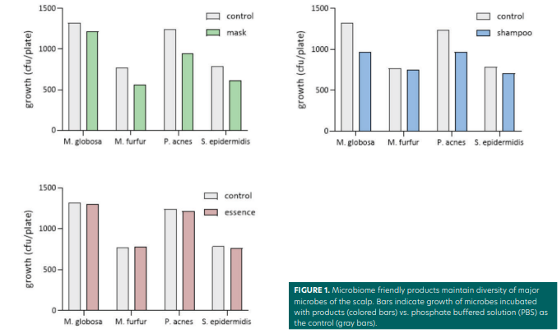
Effect of topical products on the scalp microbiome. Top, left: Results from the Nutrafol Build-Up Blocker Scalp Microbiome Exfoliating Mask. Top, right: Results from the Nutrafol Root Purifier Scalp Microbiome Shampoo . Bottom, left: Results from the Nutrafol Stress Reliever Scalp Microbiome Essense. Figure adapted from Townsend et al., New Topicals to Support a Healthy Scalp While Preserving the Microbiome: A Report of Clinical and In Vitro Studies. Journal of Clinical and Aesthetic Dermatology (2023), 16(10 Suppl 1): S4-S11.
2
Nutrafol Build-Up Blocker Scalp Microbiome Exfoliating Mask significantly reduced scalp sebum content with consistent use (P<0.05 at Day 7 and Day 28 vs. baseline). Sebum build-up, assessed by an expert grader, also improved significantly (P<0.0001 at Day 7, Day 14 and Day 28 vs. baseline). Scalp pH was not affected by the mask.
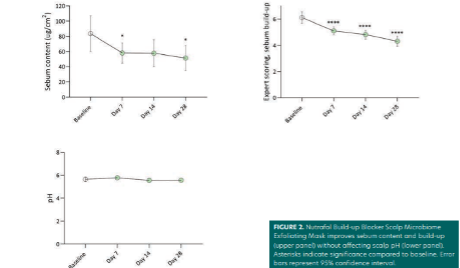
Effect of Nutrafol Build-Up Blocker Scalp Microbiome Exfoliating Mask on scalp health. Top, left: Sebum content. Top, right: Sebum build-up from expert scoring. Bottom, left: pH. * P<0.05 and **** P<0.0001 compared to baseline. Figure adapted from Townsend et al., New Topicals to Support a Healthy Scalp While Preserving the Microbiome: A Report of Clinical and In Vitro Studies. Journal of Clinical and Aesthetic Dermatology (2023), 16(10 Suppl 1): S4-S11.
3
Nutrafol Root Purifier Scalp Microbiome Shampoo significantly reduced scalp sebum content (P<0.01 at Day 14 vs. baseline) and significantly increased scalp hydration (P<0.01 at Day 7 and P<0.05 at Day 14 vs. baseline). These findings were accompanied by a significant decrease in scalp flakiness when scored by an expert grader (P<0.001 at Day 7 and Day 14, vs baseline). Scalp pH was not affected by the shampoo.
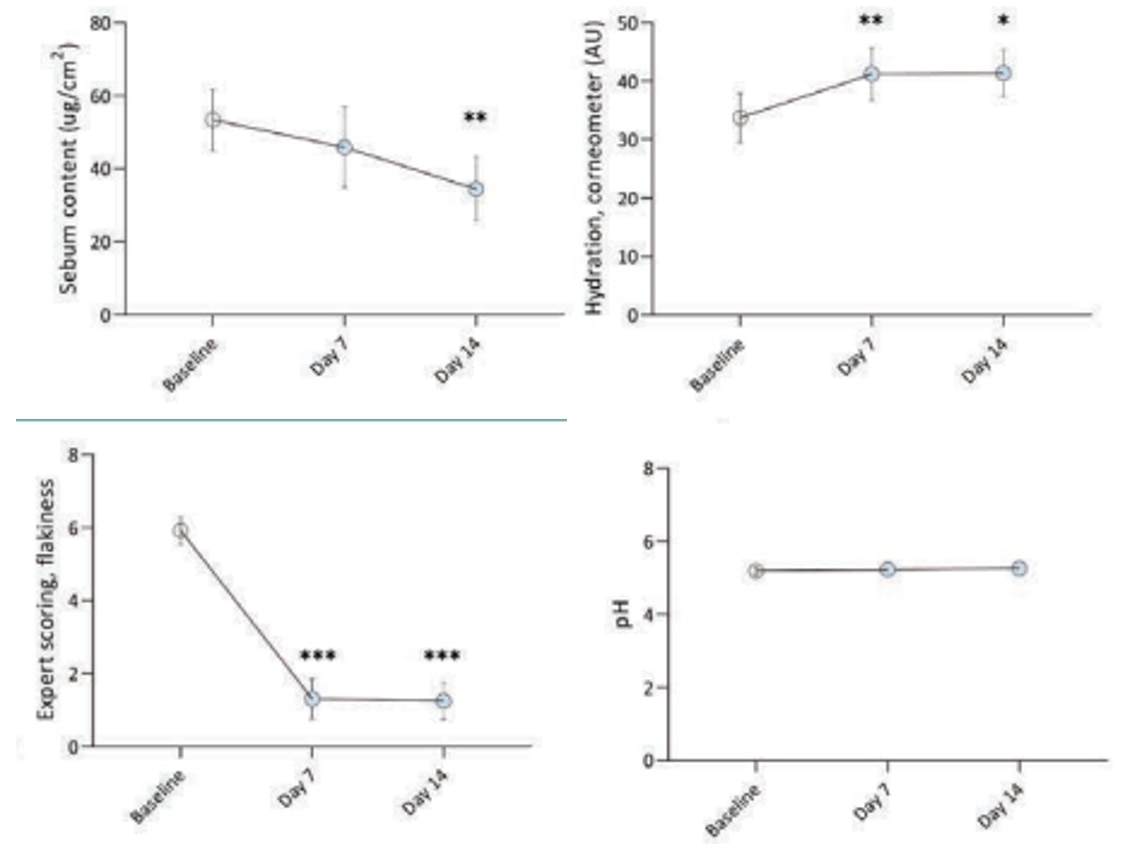
Effect of Nutrafol Root Purifier Scalp Microbiome Shampoo on scalp health. Top, left: Sebum content. Top, right: Hydration, assessed using a corneometer. Bottom, left: Expert scoring of scalp flakiness. Bottom, right: pH. *P<0.05, *P<0.01 and ***P<0.001 compared to baseline. Figure adapted from Townsend et al., New Topicals to Support a Healthy Scalp While Preserving the Microbiome: A Report of Clinical and In Vitro Studies. Journal of Clinical and Aesthetic Dermatology (2023), 16(10 Suppl 1): S4-S11.
4
Nutrafol Stress Reliever Scalp Microbiome Essense significantly decreased scalp sebum content (P<0.05 at Day 7 and Day 14) and reduced scalp redness (P<0.05 at Day 7 and P<0.01 at Day 28) and flakiness (P<0.05 at Day 28), when scored by an expert grader, relative to baseline. The essence did not have an effect on scalp hydration levels or pH.
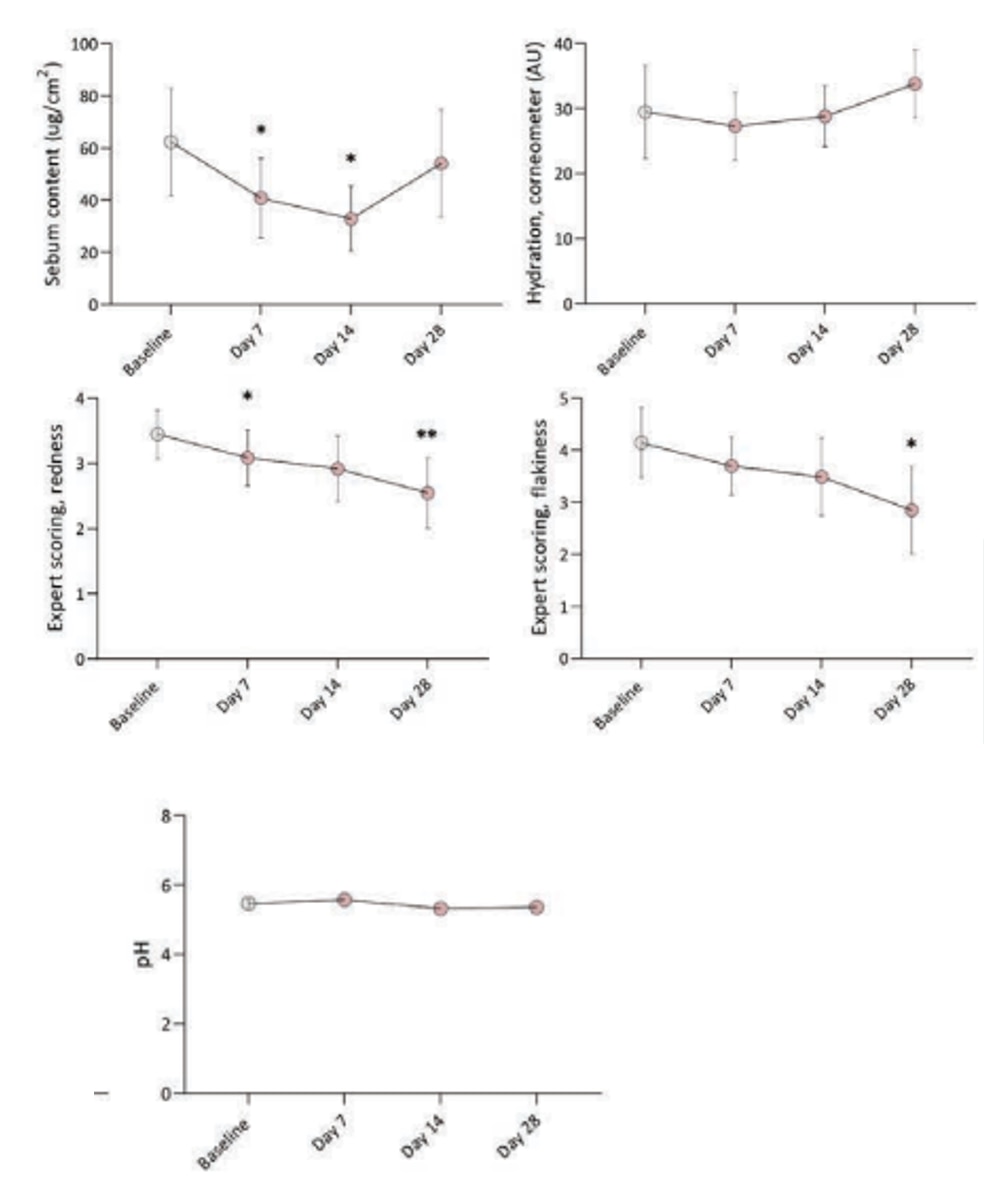
Effect of Nutrafol Stress Reliever Scalp Microbiome Essence on scalp health. Top, left: Sebum content. Top, right: Hydration, assessed using a corneometer. Middle, left: Expert scoring of scalp redness. Middle, right: Expert scoring of scalp flakiness. Bottom, left: pH. *P<0.05 and **P<0.01 relative to baseline. Figure adapted from Townsend et al., New Topicals to Support a Healthy Scalp While Preserving the Microbiome: A Report of Clinical and In Vitro Studies. Journal of Clinical and Aesthetic Dermatology (2023), 16(10 Suppl 1): S4-S11.
5
Nutrafol Strand Defender Lightweight Protective Conditioner decreased the maximum force needed to comb through all the tresses, when compared to a sodium laureth sulfate (SLES) control. The conditioner also reduced the number of broken hair fibers measured over the course of 2,000 strokes of an automated grooming device.
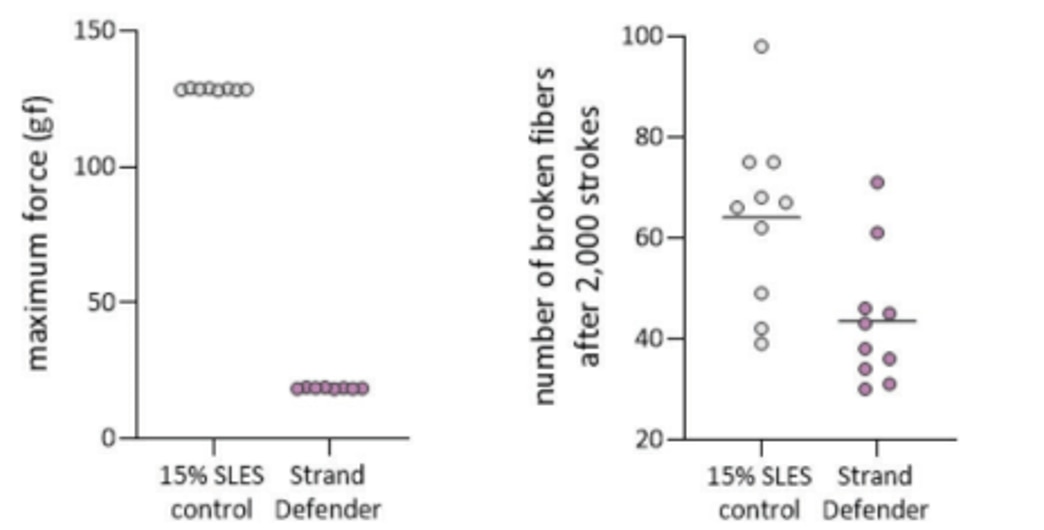
Effect of Nutrafol Strand Defender Lightweight Protective Conditioner on friction between hair strands. Left: Automated maximum force test. Right: Broken fibers, assessed via a repeat grooming test. Figure adapted from Townsend et al., New Topicals to Support a Healthy Scalp While Preserving the Microbiome: A Report of Clinical and In Vitro Studies. Journal of Clinical amd Aesthetic Dermatology (2023), 16(10 Suppl 1): S4-S11.
Access Journal
More research pages like this

- slide 1
- slide 2
- slide 3
- slide 4
- slide 5
- slide 6
THESE STATEMENTS HAVE NOT BEEN EVALUATED BY THE FOOD AND DRUG ADMINISTRATION. THIS PRODUCT IS NOT INTENDED TO DIAGNOSE, TREAT, CURE OR PREVENT ANY DISEASE.
This information is provided as a medical and scientific educational resource for the use of dieticians and other licensed healthcare professionals. This information is intended for Practitioners to use as the basis for determining whether to recommend these products to their clients. All recommendations regarding protocols, dosing, prescribing and/or use instructions should be tailored to the individual needs of the client considering their medical history and concomitant therapies. This Information is not intended for use by consumers.
What are you looking for?



© 2025 Unilever.
All rights reserved