
Intervention: Nutrafol Women’s Vegan (n = 110).
Methods: All subjects underwent clinical evaluation at baseline, Day 90 and Day 180. A region-of-interest (ROI) was defined and marked in a transitional zone between thinning and healthy hair along the frontalis bone where the frontal hairline and lateral hairline meet; this ROI was examined at all timepoints using phototrichograms to quantify total, vellus and terminal hair. Additional measurements included Global Investigator Ratings of hair growth and quality, hair shedding via pull test and subjective questionnaires (e.g., Quality of Life assessment).
Study Duration: 6 months
Eligibility Criteria:
- Female subjects aged 18-50
- Follow a plant-based lifestyle for at least 3 months, and continuing for the duration of the study
For more, plus the exclusion criteria, see:
Key Findings
1
Hair counts:
a) Nutrafol Women's Vegan significantly increased the number of terminal hairs after 90 and 180 days of treatment, relative to baseline: from 138.6 ± 37.2 to 159.3 ± 43.9 hairs per cm2 (P<0.01). This translates to a 15% increase in terminal hairs.
b) Total hair counts were also significantly increased following treatment with Nutrafol Women’s Vegan, from 150.1 ± 35.8 at baseline to 169.2 ± 42.8 hairs per cm2 at day 180 (P<0.01), translating to a 12.8% increase at Day 180.
c) Vellus hairs significantly decreased, from 11.5 at baseline to 9.9 hairs per cm2 at day 180 (P<0.01). Furthermore, a significant increase in the terminal-to-vellus hair ratio was observed at Day 90 (P<0.05) and Day 180 (P<0.01). Average hair width was also significantly increased at Day 90 and Day 180 (P<0.01 at both timepoints).
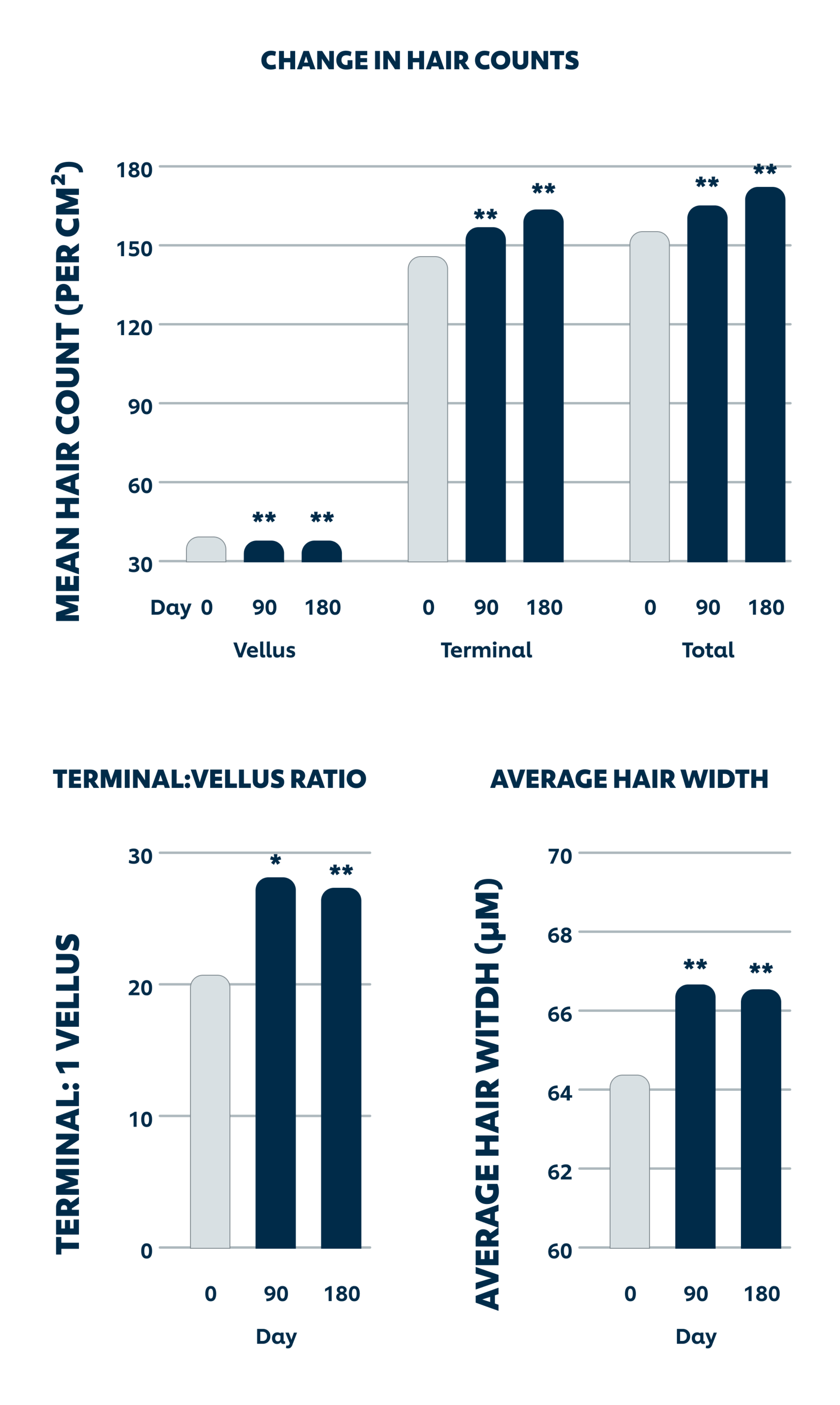
Changes in hair parameters. Top: Vellus, terminal and total hair counts; Bottom, left: Terminal-to-vellus hair ratio; Bottom; right: Average hair width. * P<0.05 and ** P<0.01, compared to baseline. Adapted from Sivamani et al., A Prospective, Multi-Center Study to Evaluate the Safety and Efficacy of a Vegan Nutraceutical to Improve Hair Growth and Quality in Females Following a Plant-Based Diet. Journal of Drugs in Dermatology (2024), 23(8):661-668.
2
Hair shedding was evaluated in four different regions of the scalp: vertex, occipital, right parietal and left parietal areas. Total hair shed combined from all regions progressively and significantly decreased throughout the study following Nutrafol Women’s Vegan treatment, from 2.0 ± 2.3 at baseline to 1.4 ± 1.5 at Day 90 and 1.0 ± 1.3 at Day 180 (P<0.01 at both timepoints relative to baseline). Closer examination of the data revealed that the right and left parietal areas of the scalp both exhibited significant reductions in shedding (P<0.01 for both regions at Day 180, relative to baseline). Meanwhile, the vertex and occipital areas did not display significant reductions.
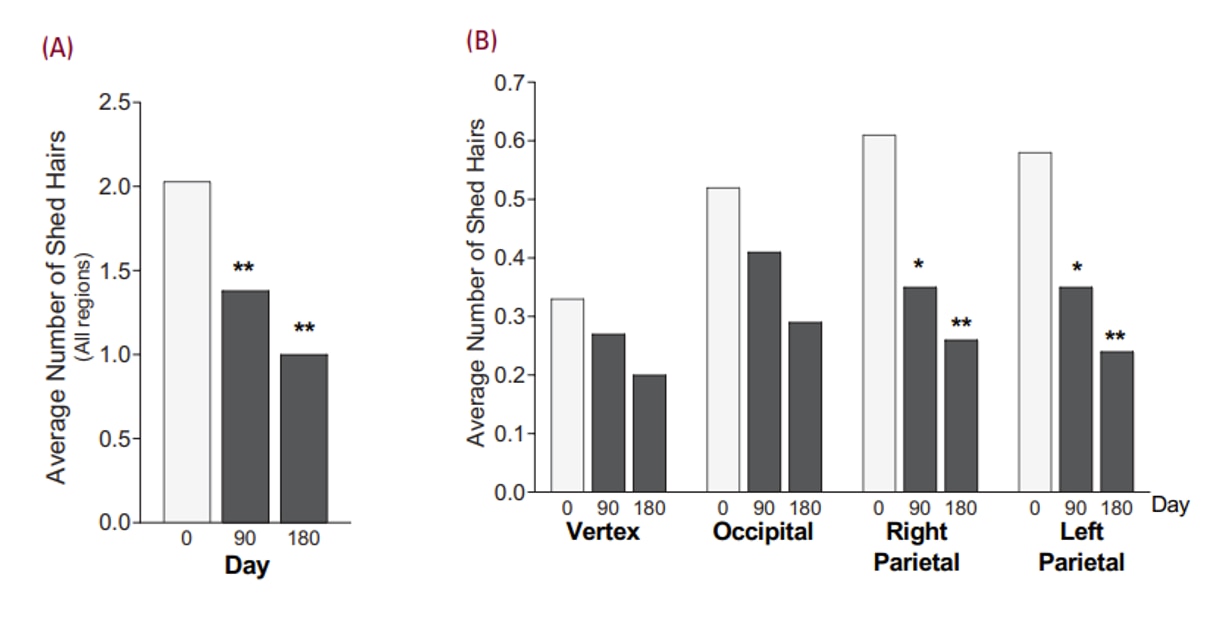
Changes in hair shedding. Left: Results from all combined regions. Right: Results from four individual regions. * P<0.05 and ** P<0.01, compared to baseline. Adapted from Sivamani et al., A Prospective, Multi-Center Study to Evaluate the Safety and Efficacy of a Vegan Nutraceutical to Improve Hair Growth and Quality in Females Following a Plant-Based Diet. Journal of Drugs in Dermatology (2024), 23(8):661-668.
3
Results from the subjective questionnaires revealed improvements in hair parameters and quality of life. Notably, 82% of subjects reported improvements in hair strength, and 85% of subjects reported improvements in overall hair quality, after 180 days of treatment.
Subjective assessment of changes in hair parameters. *Indicates a significant proportion of subjects reporting a favorable response compared with the proportion of subjects reporting an unfavorable response (P<0.01).
4
Finally, Nutrafol Women’s Vegan was well tolerated with no serious adverse events.
More research pages like this

- slide 1
- slide 2
- slide 3
- slide 4
- slide 5
- slide 6
THESE STATEMENTS HAVE NOT BEEN EVALUATED BY THE FOOD AND DRUG ADMINISTRATION. THIS PRODUCT IS NOT INTENDED TO DIAGNOSE, TREAT, CURE OR PREVENT ANY DISEASE.
This information is provided as a medical and scientific educational resource for the use of dieticians and other licensed healthcare professionals. This information is intended for Practitioners to use as the basis for determining whether to recommend these products to their clients. All recommendations regarding protocols, dosing, prescribing and/or use instructions should be tailored to the individual needs of the client considering their medical history and concomitant therapies. This Information is not intended for use by consumers.
What are you looking for?



© 2025 Unilever.
All rights reserved