
Intervention: Nutrafol Women’s Balance (n = 60).
Methods: This is an unblinded extension study, following subjects who were initially recruited to Ablon et al. (2021) At the end of the initial 6-month, placebo-controlled study, all remaining subjects entered this extended 6-month study. Subjects initially randomized to receive Nutrafol Women’s Balance continued with this supplement, and placebo-treated subjects from the original study were switched to Nutrafol Women’s Balance.
For this unblinded extension study, all subjects were additionally evaluated at Day 270 and Day 360. Terminal, vellus and total hair counts were assessed using phototrichograms. Hair shedding counts during hair washing, blinded physician global hair assessments for hair growth and quality, and responses on subjective self-assessments were also evaluated.
Study Duration: 12 months (6 months RCT + 6 months unblinded extension study)
Eligibility Criteria:
1. Females aged 40 – 65 who are perimenopausal, menopausal or post-menopausal.
2. In good health, as determined by responses to the initial study assessment.
3. Self-perceived hair thinning, confirmed on initial study assessment by the investigator.
4. Fitzpatrick I-IV photo skin types.
For more, plus the exclusion criteria, see:
Key Findings
1
Subjects who received Nutrafol Women’s Balance for the entire 12 months of the study exhibited progressive and significant increases in mean terminal hair counts. The mean number of terminal hairs increased from 68.1 at Day 0 to 77.2 at Day 360, corresponding to a significant 13.4% improvement, relative to baseline (P<0.0001).
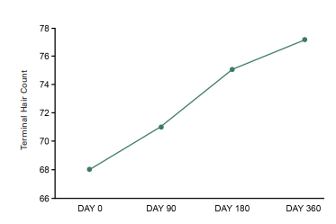
Mean terminal hair counts following 360 days of supplementation with Nutrafol Women’s Balance. Figure adapted from Ablon et al., A Long-Term Study of the Safety and Efficacy of a Nutraceutical Supplement for Promoting air Growth in Perimenopausal, Menopausal and Postmenopausal Women. Journal of Drugs in Dermatology (2022), 21(7): 783.
2
Total hair counts progressively and significantly increased from 78.4 at Day 0 to 87.6 at Day 360, representing an significant 11.7% improvement (P<0.0001 vs. baseline). Although vellus hair counts increased significantly from 10.3 at Day 0 to 11.2 at Day 180 (an 8.3% increase, P<0.05), by Day 360 had decreased to baseline levels. Shed hair counts significantly decreased by 43.2% (16.6 hairs) on Day 180 (P<0.01), remaining stable through Day 360 (P<0.01 vs. baseline).
3
Blinded investigator global hair assessments revealed progressive and significant improvements in subjects who received Nutrafol Women’s Balance for the entire 360 days. Global Hair Growth Improvement ratings increased by 43% from Day 90 to Day 180 (P<0.001) and by 25% from Day 90 to Day 360. Global Hair Quality Improvement ratings increased by 24% from Day 90 to Day 180 (P<0.05) and by 37% from Day 90 to Day 360 (P<0.005).
4
Closer examination of the placebo-controlled phase of this study revealed that there were no changes in total hair counts or terminal hair counts from Day 0 to Day 180. A small yet significant reduction in vellus hair was observed during this period (P<0.05).
Once these subjects were switched to Nutrafol Women’s Balance from Day 180, all hair counts increased significantly from Day 180 to Day 360: For total hair counts, this corresponded to a 5% increase (P<0.005); for terminal hair counts, this corresponded to a 4.3% increase (P<0.005); for vellus hair counts, this corresponded to a 11.6% increase (P<0.005).
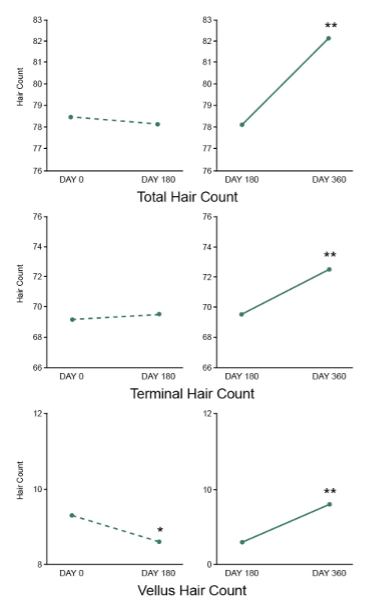
Changes in terminal hair counts, vellus hair counts, and total hairs counts during treatment with placebo for 6 months (left panel) and after switching to active treatment for 6 months (right panel).
5
Hair satisfaction questionnaires identified a significant increase in the number of subjects who reported being ‘Satisfied’ with their hair after taking Nutrafol Women’s Balance for 12 consecutive months (P<0.05).
Hair quality self-assessments revealed that 81% of subjects reported overall increased hair growth, 84% reported increased volume, 78% reported increased scalp coverage and 81% reported increased amount of new hair, from baseline until the end of the study.
The Women’s Hair Loss Quality of Life Questionnaire generally showed positive changes from baseline, including a ≥30% increased improvement for ‘Feeling Embarrassed’, ‘Avoiding Social Gatherings’ and ‘Fear of Being the Center of Attention’.
The Menopausal Rating Scale Questionnaire identified improvements and reductions in the severity of menopausal symptoms over the 12-month study period; this included symptoms (e.g., hot flashes) that were rated as ‘severe’ or ‘very severe’ at baseline being reported as ‘moderate’, ‘mild’ or ‘none’ at Day 360.
6
No unanticipated adverse events were reported.
Access Journal
More research pages like this

- slide 1
- slide 2
- slide 3
- slide 4
- slide 5
- slide 6
THESE STATEMENTS HAVE NOT BEEN EVALUATED BY THE FOOD AND DRUG ADMINISTRATION. THIS PRODUCT IS NOT INTENDED TO DIAGNOSE, TREAT, CURE OR PREVENT ANY DISEASE.
This information is provided as a medical and scientific educational resource for the use of dieticians and other licensed healthcare professionals. This information is intended for Practitioners to use as the basis for determining whether to recommend these products to their clients. All recommendations regarding protocols, dosing, prescribing and/or use instructions should be tailored to the individual needs of the client considering their medical history and concomitant therapies. This Information is not intended for use by consumers.
What are you looking for?




© 2025 Unilever.
All rights reserved