
Intervention: SHROOM TECH SPORT (n = 10) or placebo (n = 11). Participants followed the following body weight-based dosing recommendations: ≤68.2 kg = 3 capsules/day; >68.2 kg to ≤90.9 kg = 4 capsules/day, and >90.9 kg = 5 capsules/day. On training days, supplements were consumed 45 minutes prior to training session. On non-training days, supplements were consumed 1 hour after breakfast.
Methods: All participants were assigned a weekly workout consisting of two days whole-body resistance training, and two days of high-intensity interval running, on alternate days. Whole-body resistance training included squats, bench and accessory movements. High-intensity interval training included 10 sets of intervals, alternating between fast and slower running speed. Training performance was evaluated weekly, and body composition, overall training outcomes and blood sample collection (for hormone profiling) was evaluated at baseline, week 7 and week 14.
Study Duration: 14 weeks
Eligibility Criteria:
- College-aged males.
- Have at least 1 year of recreational exercise with a minimum of 3X/week.
For more, plus the exclusion criteria, see:
ClinicalTrials.gov
Key Findings
1
The 14-week training protocol significantly improved percent body fat, bench press and squat strength in both groups (P<0.05 for all, relative to baseline). SHROOM TECH SPORT did not significantly outperform placebo on any of these measurements.
2
Examination of weekly exercise performance data revealed some small training improvements in the SHROOM TECH SPORT Group relative to placebo:
a) For resistance training weekly performance, classifying the lifting intensities into four categories (low, moderate, high and maximal) revealed that SHROOM TECH SPORT significantly increased the number of repetitions performed at moderate intensity for bench relative to placebo (29±1 vs. 25±3 for SHROOM TECH SPORT and placebo respectively, P=0.02).
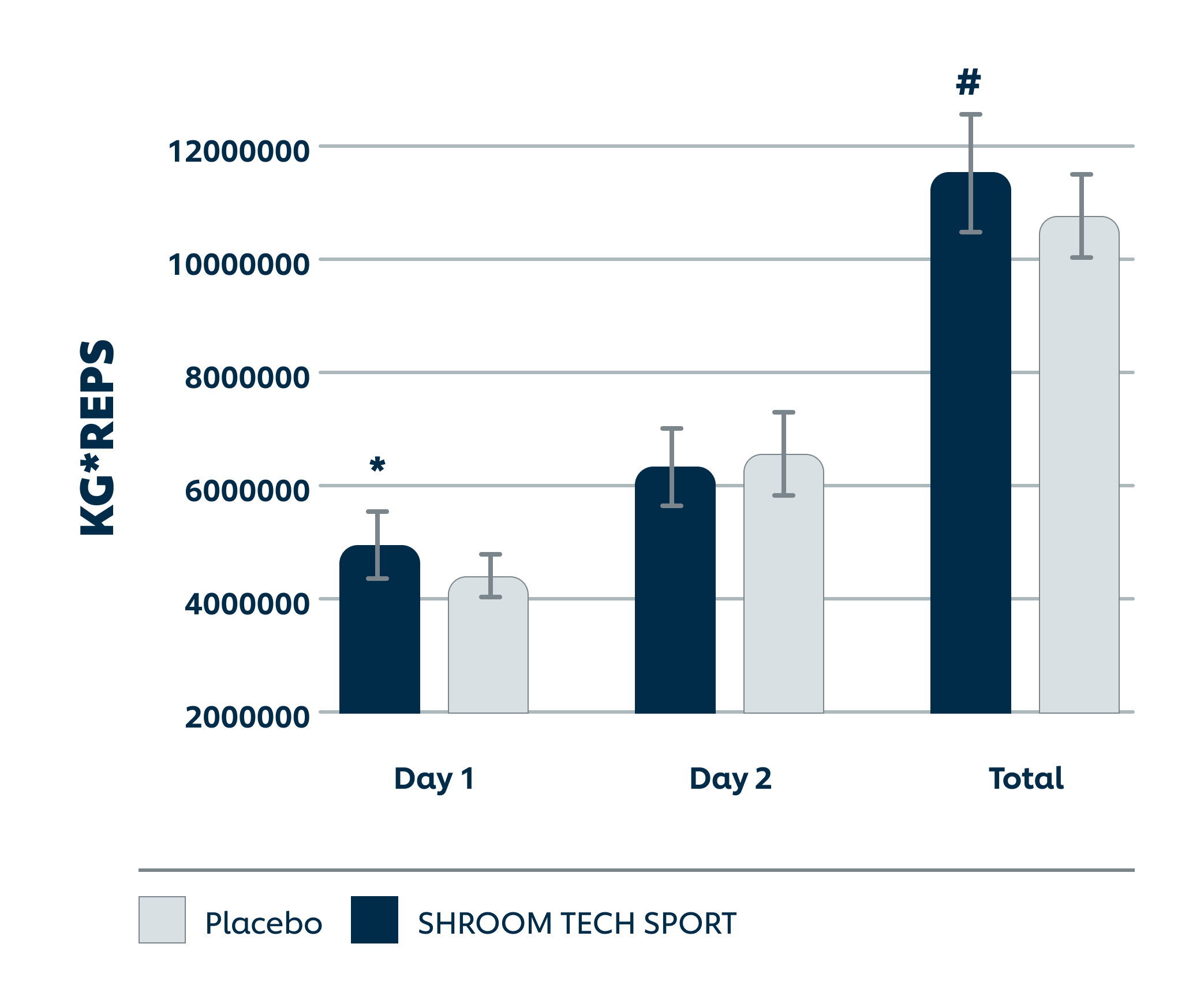
b) Workload (i.e., total weight x repetitions completed) was examined for each individual resistance training day, and the combined days (‘Total’). At day 1, the SHROOM TECH SPORT group exhibited increased resistance training workload relative to placebo (P<0.05). For total workload, a similar yet non-significant trend towards improved performance in the SHROOM TECH SPORT group was identified (P=0.08 vs. placebo).
c) A secondary analysis of daily run performance identified significantly improved performance at week 3 in the SHROOM TECH SPORT group for the “fast” day (P=0.02) and total run time (P=0.01), relative to placebo. These performance domains were also significantly better in the SHROOM TECH SPORT group at week 4, but not at any of the other timepoints.
Workload for resistance training. * P<0.05 and # demonstrates a trend towards significance. Adapted from Kreipke et al. (2020).
3
These modest improvements in weekly exercise performance did not result in differences in overall training outcomes in the SHROOM TECH SPORT group vs. placebo. Anthropometrics and hormone profiles were also not significantly different between the two groups.
Access Journal
More research pages like this

- slide 1
- slide 2
- slide 3
- slide 4
- slide 5
- slide 6
THESE STATEMENTS HAVE NOT BEEN EVALUATED BY THE FOOD AND DRUG ADMINISTRATION. THIS PRODUCT IS NOT INTENDED TO DIAGNOSE, TREAT, CURE OR PREVENT ANY DISEASE.
This information is provided as a medical and scientific educational resource for the use of dieticians and other licensed healthcare professionals. This information is intended for Practitioners to use as the basis for determining whether to recommend these products to their clients. All recommendations regarding protocols, dosing, prescribing and/or use instructions should be tailored to the individual needs of the client considering their medical history and concomitant therapies. This Information is not intended for use by consumers.
What are you looking for?




© 2025 Unilever.
All rights reserved